Every so often I encounter some statement online which perpetuates some slavery myth or other. Those myths are not entirely unreasonable – they’re very often applicable to the largest group of descendents of victims of one of the most recent episodes of the slave trade.
But they’re still myths and they distort the history of slavery.
1. Slavery is History
Nope. Estimates of the number of people held as slaves today vary from 25 million to 43 million.
And whilst legal slavery has been abolished world-wide, the last country with legal slavery (Mauritania) didn’t abolish it until 1981, and it wasn’t criminalised until 2007. There are supposedly more anti-slavery activists in prison than slave owners.
2. Only Africa
Slavery has existed throughout history and in every part of the world. For example, the Domesday book (1086) documented that 10% of England’s population were slaves. Indeed the port of Bristol owes its success to the salve trade, but not the one involving African slaves, but Anglo-Saxon slaves – 1,000 years earlier.
3. Slave Traders Weren’t All White
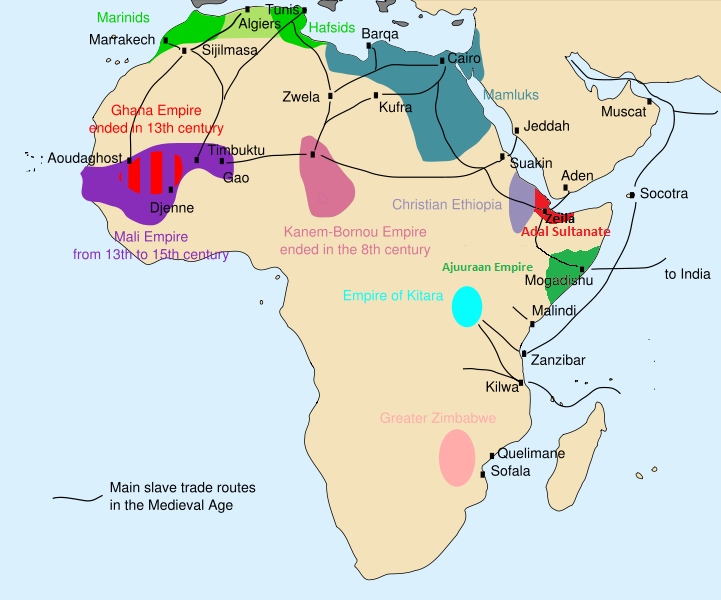
When white dudes rocked up at African ports (yes really) and asked if there were any slaves for sale, the slave trade was already centuries old. It’s hard to ascertain just how many free people were enslaved by each group, but what we know of African history makes it plain that many if not most of the slaves shipped to the Americas were sold to slave traders by other slave traders; native slave traders.
For an example look at the history of Dahomey (and this was not an isolated example).
4. Not All Slaves Were Black
In the early modern period the overwhelming majority of slaves traded were African, but the slave trade (even during this period) did include white folk.
For example, the Barbary coast pirates enslaved up to a million Europeans by seizing ship’s crews and raiding coastal settlements (mostly Spain and Italy but England and Ireland weren’t immune). Despite punitive military expeditions from all over Europe (and the US), the slave trade wasn’t finished off until the French invaded.
And that ignores the amount of slaves captured by the Ottoman Empire in Eastern Europe.
5. It Wasn’t Just The Atlantic Slave Trade
As you can see from the previous map, the trade in African slaves doesn’t just predate the Atlantic slave trade (and predates it by a long time), but it continued even after the Atlantic slave trade. Numbers are understandably somewhat vague, but it seems likely that the Arabian slave trade was at least half of the Atlantic slave trade (~12 million) and some estimates put it at parity.
6. Britain’s Industrial Revolution was Funded By The Slave Trade
This is still open to argument, and there are serious historians on both sides of the debate. It is common to argue that the profits from the slave trade were used to fund the industrial revolution.
But :-
- There are not unreasonable arguments to show that the profits from the slave trade were never enough to fully fund the industrial revolution. Some did for sure, but the aristocratic landlords would have far more money to invest.
- Those making money from the slave trade would have been more interested in investing in property than a riskier industrial venture. Social advancement in England/Britain (or any European country at the time) was through agricultural land ownership and in the long term it was profitable too.
The other thing that is overlooked is that considerable profits were made by African slave traders; that money didn’t go towards investment in Britain’s Industrial Revolution.
7. Britain Only Opposed The Slave Trade When It Become Economically Redundant
So Britain only started combatting the slave trade when slavery was no longer profitable for the British? Any number of slave traders (including African slave traders) would have begged to disagree – slavery (or at least the slave trade) remains profitable today or it wouldn’t exist.
And Britain didn’t just oppose the slave trade with words; it put its money where its mouth was and funded the West Africa Squadron. Some say it was the most expensive international moral crusade in modern history.
Final Word
Slavery is repugnant to every decent human being well deserved of its status as a crime against humanity. And there is plenty of blame to go around – Britain should have banned the Atlantic slave trade when it began not several centuries later; so should the Portuguese (who shipped twice as many slaves). Hell, why were African kingdoms fighting wars just to capture slaves not also condemned?
This is not supposed to be a political narrative – specifically this isn’t supposed to support “white supremacy”. The only statement I would say on that kind of subject is that evil-doers can be found amongst all ethnic groups.
Of course this is from the perspective of the whole-world, and more geographically localised slavery may well be different in nature.


